

🏔️ Shimla — Queen of Hill Stations
Shimla, the capital of Himachal Pradesh, is one of India’s most iconic and beloved hill stations. Known as the “Queen of Hills”, it sits majestically in the lower Himalayas and blends colonial charm with stunning natural beauty.
🏛️ History of Shimla
Ancient & Pre-Colonial Period
Before the British arrived, the area around Shimla was a dense forest inhabited by the Gurkhas of Nepal who had captured much of this Himalayan region in the early 19th century. The local tribes worshipped Goddess Shyamala Devi (a form of Kali), and it is from her name that “Shimla” is derived. The region was largely uncharted and sparsely populated.
British Discovery (1819)
The British first took notice of Shimla after the Anglo-Gurkha War (1814–16), when the area came under British control. In 1819, Lieutenant Ross of the British Bengal Infantry built the first British cottage in Shimla. Word spread quickly about its pleasant climate — a blessing compared to the scorching plains.
Summer Capital of British India
By 1864, Shimla was officially declared the Summer Capital of British India — the seat of the entire British Indian government from April to October every year. The Viceroy, Commander-in-Chief, and all major administrative offices would move here annually. Magnificent buildings were constructed:
- Viceregal Lodge (1888) — official residence of the Viceroy, now the Indian Institute of Advanced Study (IIAS)
- Christ Church (1857) — second oldest church in North India
- Gaiety Theatre (1887) — one of India’s finest colonial theatres
- Gorton Castle — headquarters of the Indian Army
Historic Agreements Signed in Shimla
| Agreement | Year | Significance |
|---|---|---|
| Shimla Convention | 1914 | Defined Tibet-India border (McMahon Line) |
| Shimla Agreement | 1972 | India-Pakistan peace treaty after 1971 war (signed by Indira Gandhi & Zulfikar Bhutto) |
Post-Independence
After independence in 1947, Shimla became the capital of Punjab and later, when Himachal Pradesh was formed in 1971, it became its state capital. It has retained its colonial character while growing into a modern city.
🌍 Geographical Conditions
Location & Altitude
- Shimla lies at 31.1°N latitude and 77.2°E longitude
- Altitude: 2,206 m (7,238 ft) above sea level
- Situated in the Shivalik ranges of the lower Himalayas
- Surrounded by dense forests of oak, rhododendron, pine, and deodar cedar
Topography
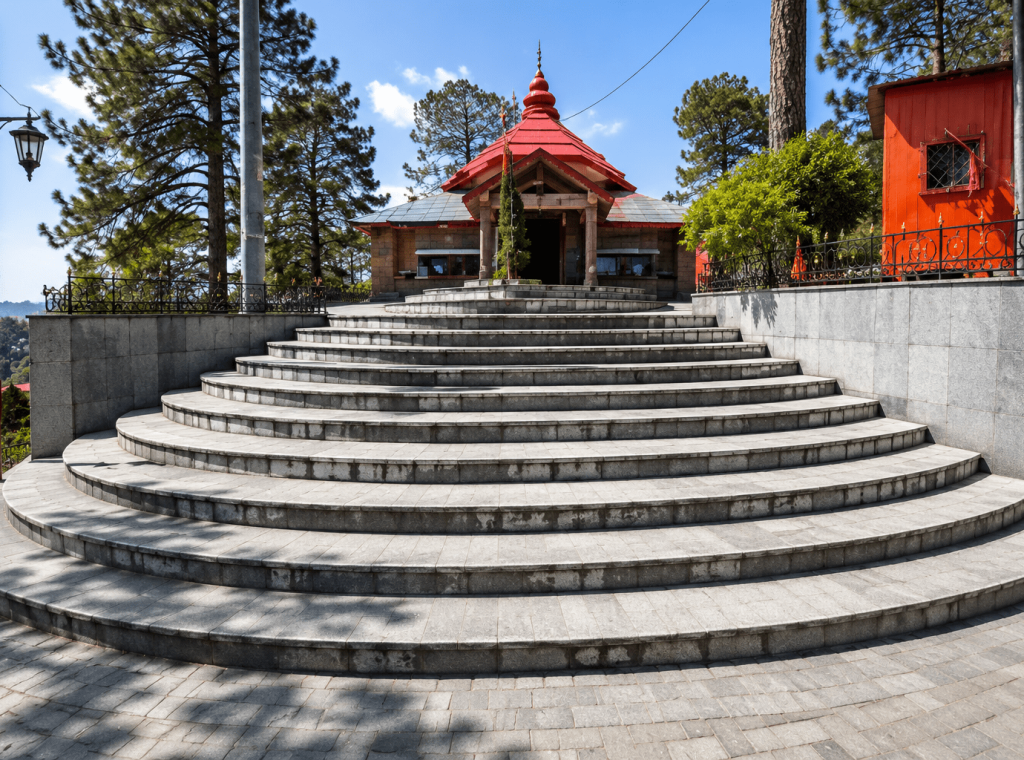
Shimla is built along a crescent-shaped ridge stretching about 12 km east to west. The terrain is hilly and undulating, with deep valleys and gorges on either side. The Jakhu Hill (2,455 m) is the highest point near the town, topped by the famous Jakhu Temple dedicated to Lord Hanuman.
Climate
| Season | Months | Temperature | Conditions |
|---|---|---|---|
| Spring | March–April | 8°C – 20°C | Flowers bloom, pleasant |
| Summer | May–June | 15°C – 28°C | Best weather, peak tourism |
| Monsoon | July–September | 15°C – 25°C | Heavy rain, landslides possible |
| Autumn | October–November | 5°C – 20°C | Clear skies, great views |
| Winter | Dec–February | −4°C – 10°C | Heavy snowfall, magical |
- Shimla receives snowfall typically from December to February — the town transforms into a white wonderland
- Annual rainfall is around 1,575 mm, mostly during monsoon
- Summers are cool and refreshing (why the British loved it!)
- Winters can be bitterly cold with temperatures dropping below freezing
Rivers & Surroundings
- The Sutlej River flows through the valleys below Shimla
- Nearby areas include Chail (2,250 m), Kufri (2,625 m), and Naldehra (2,044 m)
- Dense forests cover most of the hillsides, home to leopards, Himalayan black bears, langurs, and diverse birdlife
🚗 How to Reach Shimla
✈️ By Air
The nearest airport is Jubbarhatti Airport (Shimla Airport), about 23 km from the city centre. However, it handles limited flights due to the challenging terrain. Chandigarh Airport (~115 km) is the more practical option, with frequent flights from Delhi, Mumbai, Bengaluru, and other major cities. From Chandigarh, taxis and buses run regularly to Shimla (2.5–3 hrs).
🚂 By Train — The Famous Toy Train!
Shimla is connected by the iconic Kalka–Shimla Railway, a UNESCO World Heritage Site (2008). This narrow-gauge mountain railway runs 96 km from Kalka to Shimla, passing through 102 tunnels, 800+ bridges, and 919 curves — an engineering marvel built in 1903.
| Train | Duration | Experience |
|---|---|---|
| Shivalik Deluxe Express | ~5 hrs | Best views, comfortable |
| Himalayan Queen | ~5.5 hrs | Classic, popular |
| Rail Motor Car | ~4 hrs | Fastest toy train option |
Kalka is well-connected to Delhi by mainline trains like the Kalka Mail and Shatabdi Express (4–5 hrs from Delhi).
🚌 By Road
Shimla is excellently connected by road:
- From Delhi: ~350 km via NH 44 → Chandigarh → NH 5 to Shimla (7–8 hrs by car or bus)
- From Chandigarh: ~115 km, about 2.5–3 hrs
- From Manali: ~270 km, about 7–8 hrs
- HRTC (Himachal Road Transport Corporation) runs Volvo and ordinary buses from Delhi’s ISBT Kashmere Gate directly to Shimla — overnight buses are very popular
- Private taxis and cabs are available from Chandigarh and Delhi
🚖 Local Transport in Shimla
- Lift (elevator): A public lift connects Cart Road (lower town) to Mall Road (upper town)
- Walking: Most of the main town — Mall Road, Ridge, Lakkar Bazaar — is pedestrian-only
- Taxis & autos for nearby destinations like Kufri, Naldehra, Chail
🗺️ Quick Summary
| Detail | Info |
|---|---|
| State | Himachal Pradesh |
| Altitude | 2,206 m |
| Distance from Delhi | ~350 km |
| Distance from Chandigarh | ~115 km |
| Best Time to Visit | May–June (summer) & Dec–Jan (snow) |
| Famous For | Colonial heritage, toy train, snowfall, Mall Road |
| Language | Hindi, Pahari |
Shimla is a destination that never disappoints — whether you come for the snowfall in winter, the cool breeze in summer, the colonial architecture, or the legendary toy train ride through the mountains. 🚂❄️🏔️
Popular Places in Shimla

Mall Road & The Ridge — Heart of Shimla
Mall Road is the lifeline of Shimla — a bustling, car-free promenade lined with shops, cafes, restaurants, and colonial-era buildings. It connects the Scandal Point to the Lakkar Bazaar, and is perfect for leisurely evening strolls.Just above it lies The Ridge — a large open esplanade offering sweeping views of the surrounding mountains.
Christ Church — Colonial Masterpiece
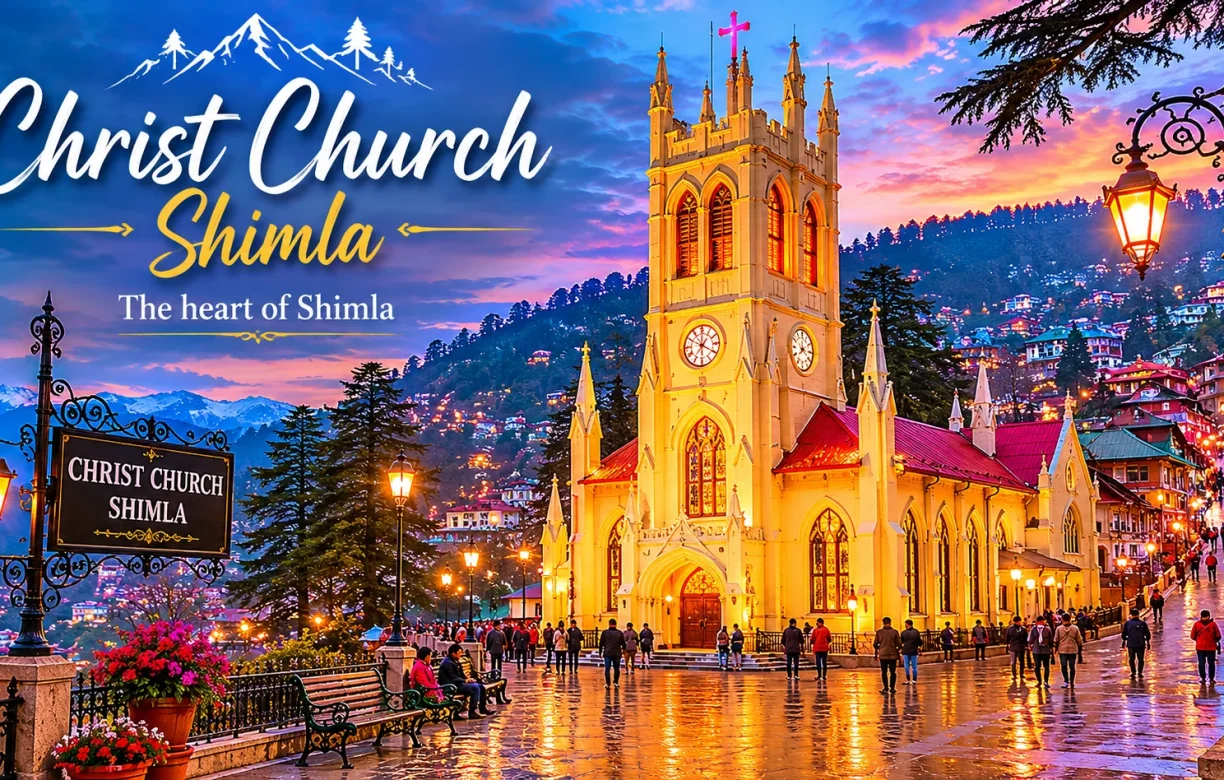
Standing proudly on The Ridge, Christ Church (1857) is the second oldest church in North India and one of Shimla’s most iconic landmarks. Built in neo-Gothic style with beautiful stained glass windows depicting Faith, Hope, Charity, Fortitude, Patience and Humility, it is a stunning example of British colonial architecture. The trek through oak and rhododendron forest to reach the temple is half the experience. Watch out for the friendly (but mischievous!) monkeys!
Viceregal Lodge (Rashtrapati Niwas) —
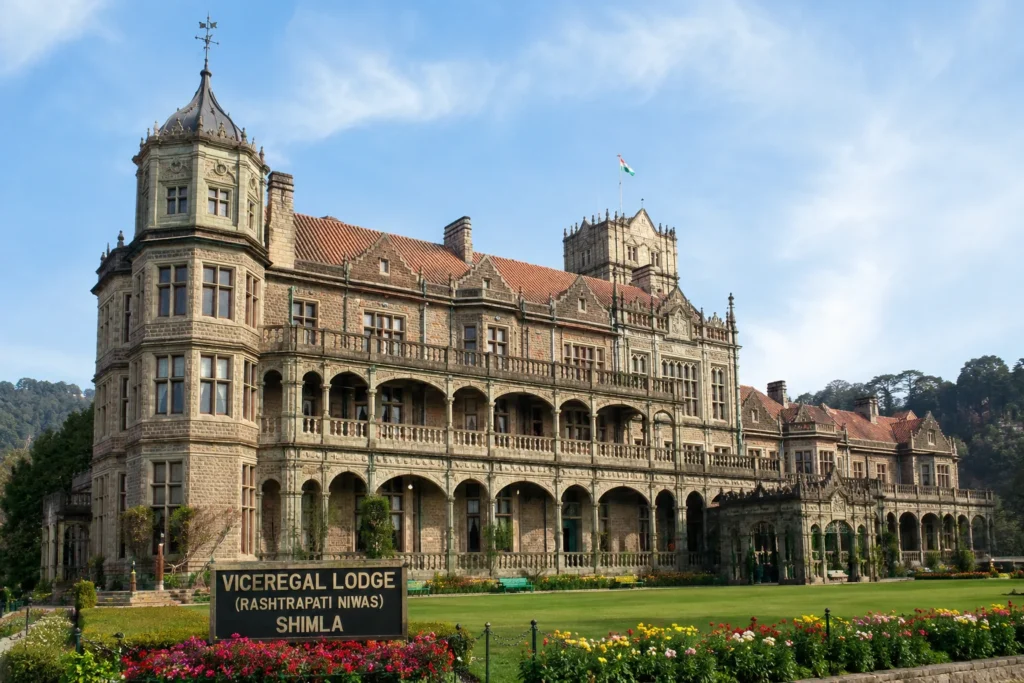
One of the finest examples of British colonial architecture in Asia, the Viceregal Lodge was built in 1888 as the official residence of the Viceroy of India. Built in Elizabethan-Tudor style with Scottish Baronial touches, it is now home to the Indian Institute of Advanced Study (IIAS). Three crucial events in Indian history were planned here — the Shimla Conference (1945), the Indian Independence Act, and the Partition Plan. The surrounding gardens are immaculate.

Kufri — Mini Adventure Hub
Just 16 km from Shimla at 2,625 m altitude, Kufri is a small but exciting hill resort famous for snow activities in winter and adventure sports in summer. The Himalayan Nature Park here is home to deer, snow leopards (in enclosures), and Himalayan birds. In winter, visitors enjoy skiing, tobogganing, and yak/horse rides in the snow. The viewpoint at Mahasu Peak offers stunning Himalayan panoramas.

Jakhu Temple — Highest Point of Shimla
The beautiful Chadwick falls lies only a few kilometers away from Summer Hill in Shimla. This stunning waterfall flows from a height of 1586 meters and is encircled by thick green woods and steep hills of pine and deodar from all sides and looks amazing especially during the rain. One of the favorite spots for sightseeing in Shimla,
Sankat Mochan Temple
At 2,044 m, Naldehra is a peaceful hamlet about 22 km from Shimla, famous for having one of India’s oldest and most scenic golf courses — laid out by Lord Curzon in 1905. Surrounded by cedar and pine forests, Naldehra is perfect for those who want to escape the bustle of Shimla town. The Naldehra Fair held in June is a colourful local festival worth witnessing.

Tara Devi Temple — Hilltop Goddess
Perched on a hilltop about 11 km from Shimla on the Kalka–Shimla highway, Tara Devi Temple is an 8th-century shrine dedicated to Goddess Tara (a form of Durga). The temple offers sweeping views of Shimla town and the surrounding forested hills. The annual fair (mela) during Navratri draws thousands of devotees.
Lakkar Bazaar
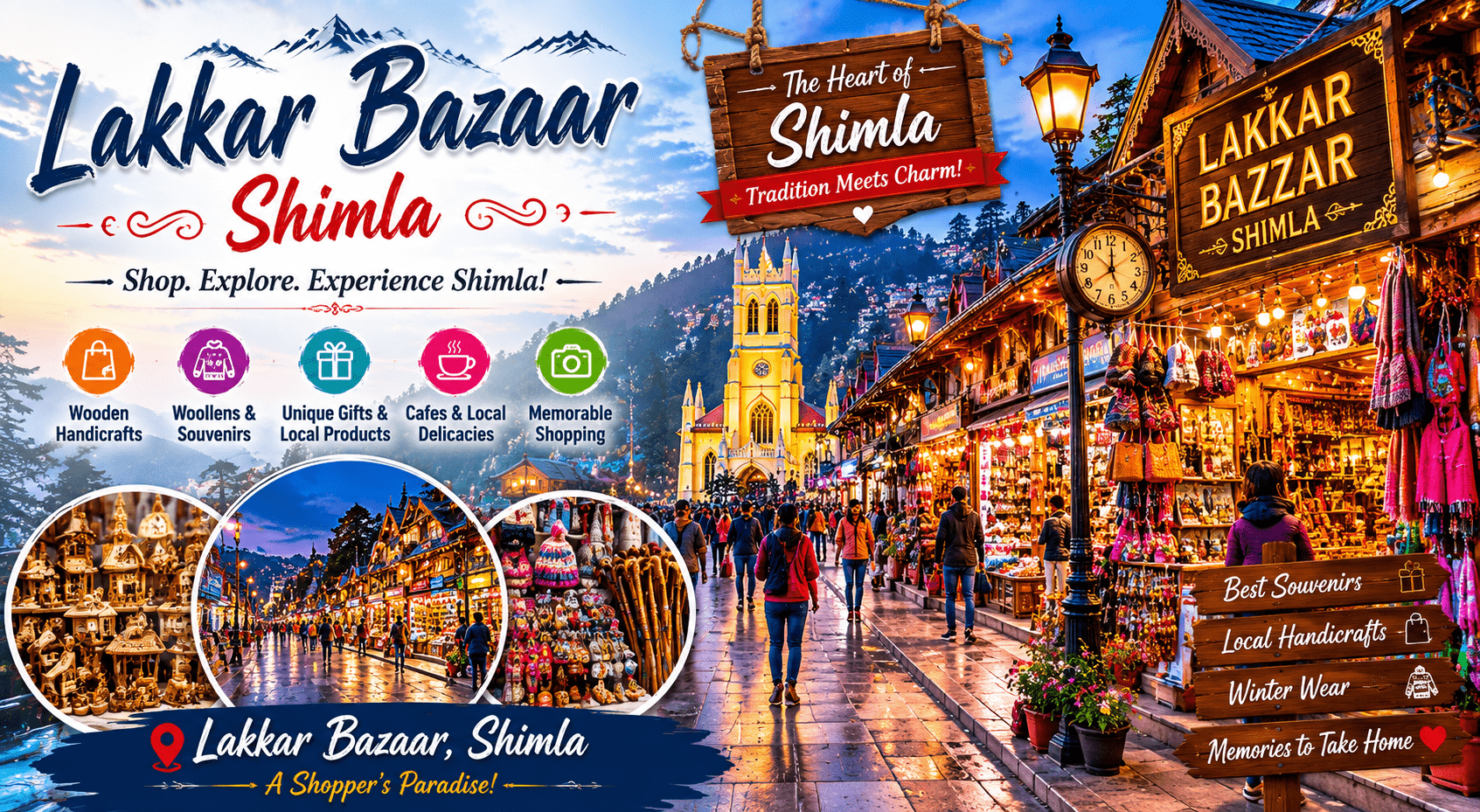
Lakkar Bazaar (Wood Market) at the end of Mall Road is famous for wooden handicrafts, toys, furniture and souvenirs unique to Himachal Pradesh. Walking through the Lower Bazaar gives a glimpse of authentic local life — a sharp contrast to the colonial upper town.
- Best for: Shopping for wooden crafts, local street food, real Shimla life
Shimla Tourist Map — At a Glance
| Place | Distance from Mall Road | Specialty |
|---|---|---|
| The Ridge & Christ Church | 0 km | Colonial landmark, views |
| Jakhu Temple | 2 km | Ancient temple, Hanuman statue |
| Viceregal Lodge | 2.5 km | British heritage, history |
| Chadwick Falls | 7 km | Waterfall, forest |
| Tara Devi Temple | 11 km | Goddess temple, panoramic views |
| Kufri | 16 km | Snow sports, nature park |
| Naldehra | 22 km | Golf course, cedar forests |